


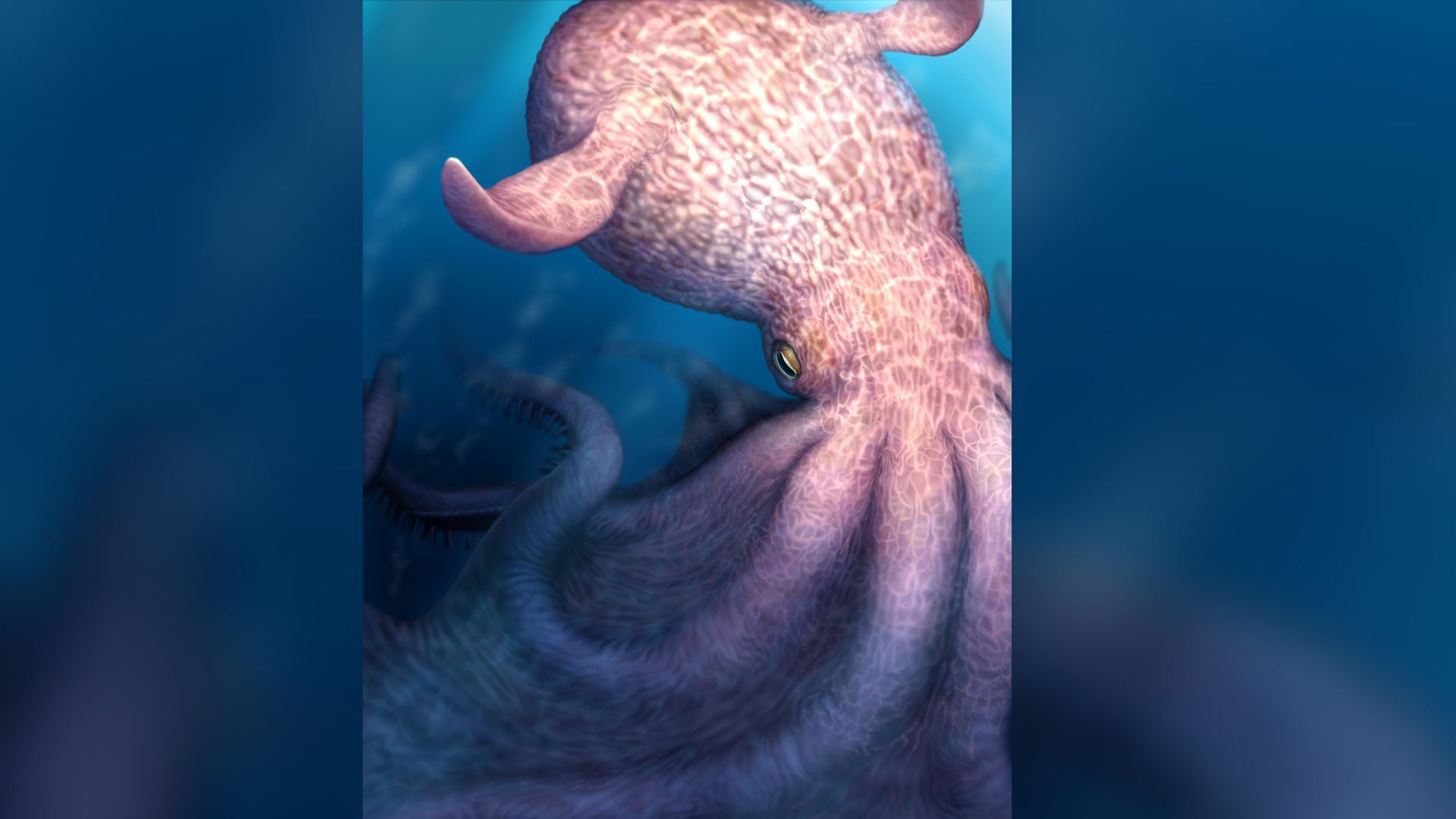
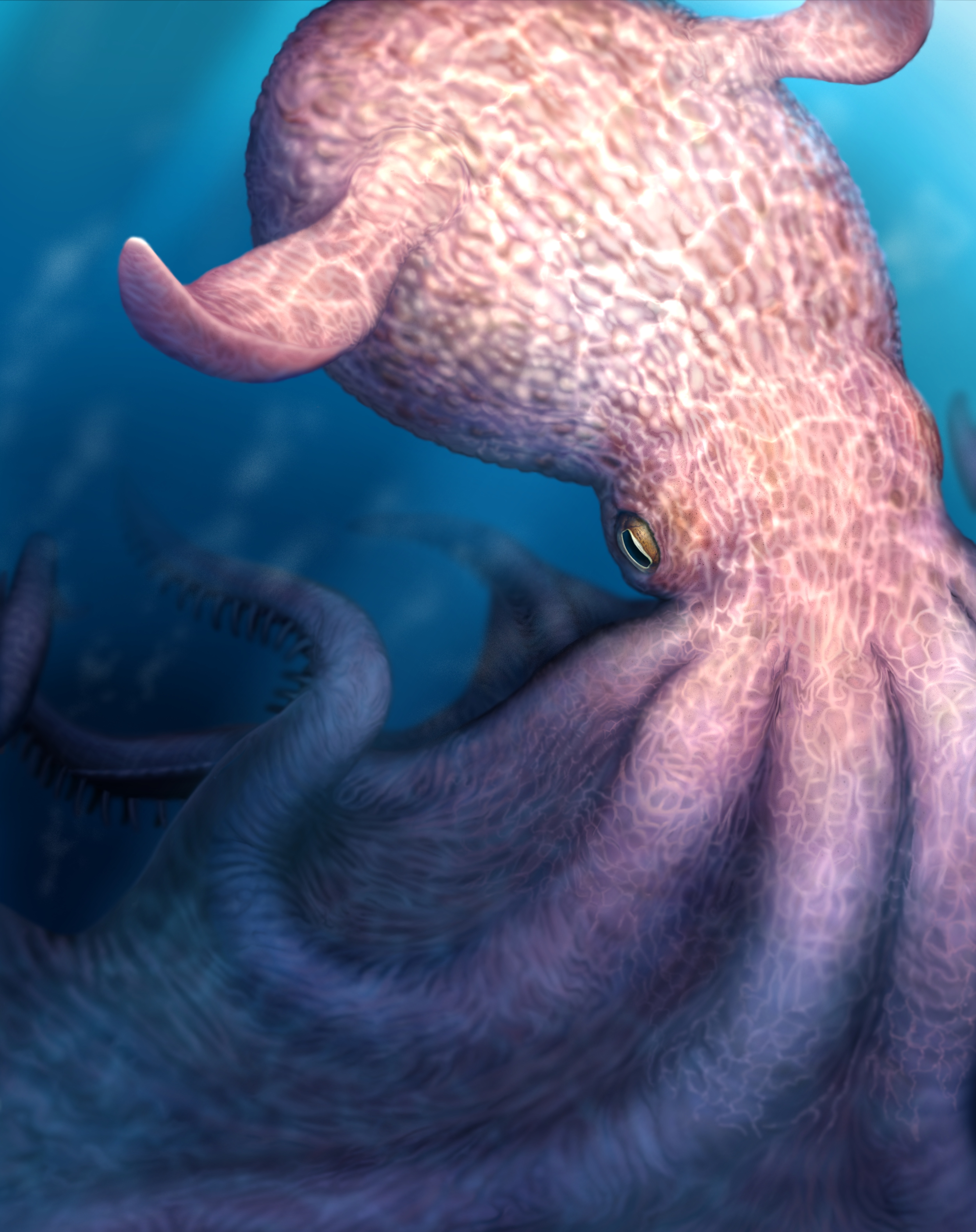
Scientists have identified a giant finned “Kraken” octopus that may have grown up to 62 feet (19 meters) long. The giant creature roamed the oceans during the Cretaceous period and may be the largest invertebrate ever discovered.
The discovery suggests that scientists need to reconsider the order of the oceans during the Cretaceous period (145 million to 66 million years ago).
you may like
“These findings revise the view of the Cretaceous ocean as a world dominated only by large vertebrates,” study co-author Yasuhiro Iba, a paleontologist at Hokkaido University in Japan, told LiveScience in an email. “They show that the octopus, a large invertebrate, also occupied the top of the food chain.”
Other experts say these size estimates are at the upper end of a large possible range. Still, the discovery raises questions about the Cretaceous marine landscape, including how these species were able to grow so large and whether even larger marine species existed after the Cretaceous period, the researchers said.
Hunt down the apex predator
Species at the top of the food chain form ecosystems and their prey respond with evolved protective measures such as hard shells. To understand how Cretaceous marine ecosystems functioned, Iba said it was essential to understand which species held the top positions.
Until now, it was thought that all top dogs were vertebrates, such as mosasaurs and plesiosaurs. But the lack of preserved evidence of soft-bodied octopuses makes their place in the Cretaceous food chain a complete mystery, the authors say in their study.
“Octopuses are known today as highly intelligent animals, but their lack of a hard outer shell makes them very difficult to study in deep time,” Iba said. “The main motivation for this study was to uncover the history of this largely invisible octopus.”
For this study, the researchers re-evaluated 15 octopus jaw fossils previously unearthed in Japan and Vancouver Island. They also discovered 12 new Cretaceous octopus jaw fossils in Japan using cutting-edge digital fossil mining techniques. Taken together, these reveal two extinct species of long-finned octopus: Nanaimoteutis geretskii and Nanaimoteutis hagarti.
The N. zeretskii fossil was unearthed in rock that is between 100 million and 72 million years old, setting the oldest known octopus back by about 5 million years and the long-finned octopus by 15 million years, the authors said in their study.
What to read next
The researchers then compared the size, shape, and wear marks of all 27 jaws to those of modern octopuses, reconstructing their body size, feeding habits, and position in the food web.
The size of a living octopus’ mantle (the bulging organ sac above the eyes) is related to the length of its jaws. The total length of modern long-bodied octopuses is approximately 4.2 times the length of the mantle.
Iba and his colleagues used this to estimate how bulbous the mantles of N.jeletzkyi and N.haggarti are. From there, they were able to calculate the possible total length of the long-dead creature.
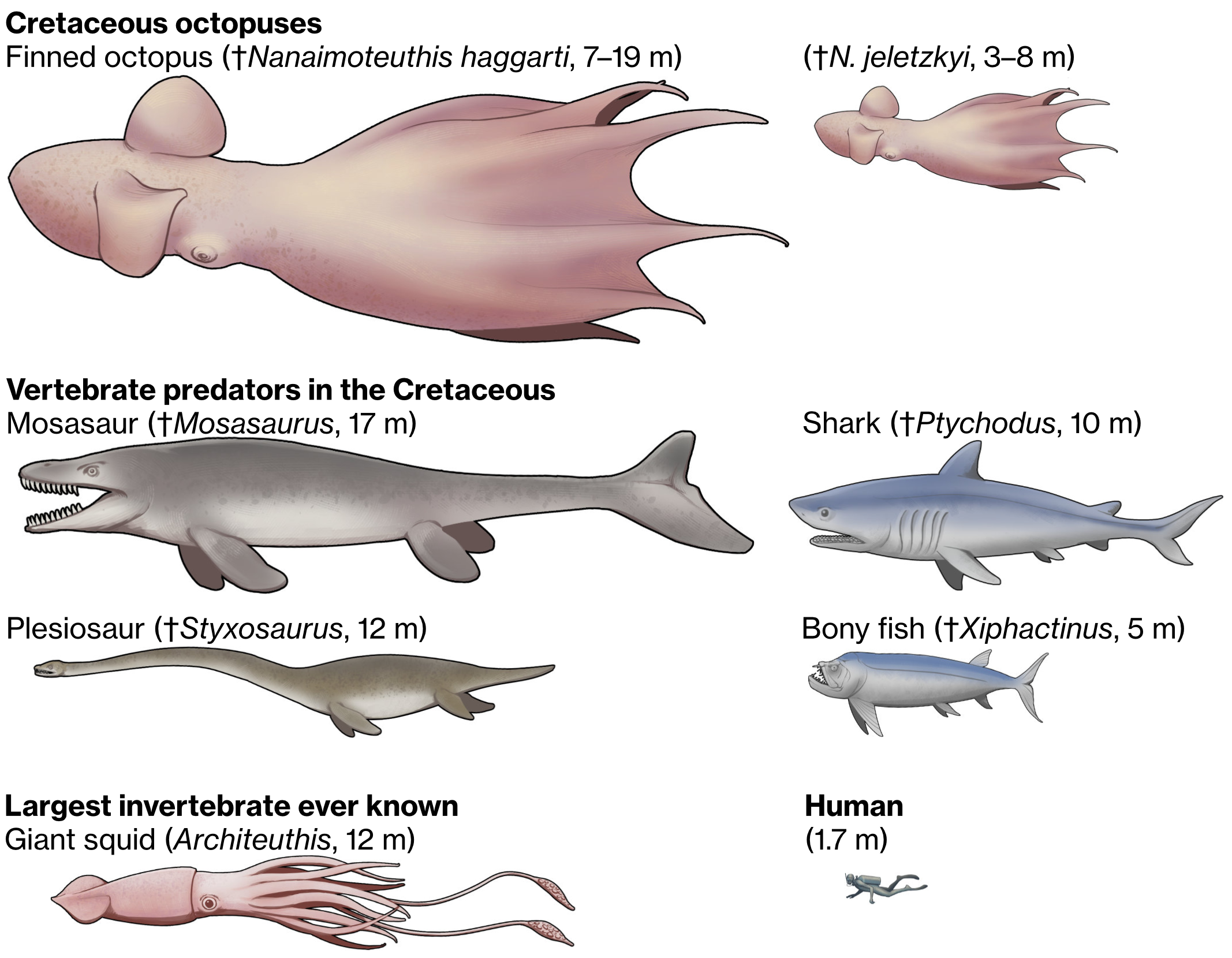
Based on the largest jaws of each species, the researchers estimated that N. jeletzkyi’s maximum length was about 10 feet to 26 feet (3 meters to 8 meters), while N. hagarti’s maximum length was about 23 feet to 62 feet (7 meters to 19 meters). Because of this, N. hagarti is likely the largest invertebrate ever discovered, and “has one of the largest body sizes of all Cretaceous marine organisms,” the authors write in their study. (The modern giant squid, Architeuthis dux, reached a length of about 40 feet (12 m); Cretaceous mosasaurs reached a length of about 56 feet (17 m).)
The kraken’s jaws also showed signs of heavy wear, and the markings suggested that these animals used their entire jaws to dismember their hard-shelled prey. Based on the reconstructions, the anterior end of the jaws of both species had been shaved off by as much as 10% of its total size on one side. This skewed loss suggests lateralized behavior, which is associated with being more cerebral, the authors said in the study.
“These weren’t just giant octopuses, they were giant, intelligent, and very fearsome marine predators,” Iba said.
But while experts praised the digital fossil-hunting techniques used in the study, they questioned the size estimates for each species.
The researchers estimated the size of N. zeretskii and N. hagarti using “error-prone” averages of the jaw-to-mantle and mantle-to-total size relationships of extant species. So the results imply a wide range of possible sizes for both species, René Hofmann, a paleontologist specializing in fossil cephalopods at Germany’s Ruhr University Bochum, told Live Science via email.
Also, their huge size doesn’t necessarily mean these invertebrates are top predators, Hoffman added.
Christian Kruk, a professor of paleontology at the University of Zurich in Switzerland and an expert on cephalopod evolution, agrees. He said that while the estimates were within the range of possibilities, some uncertainty was inevitable. “There’s no question that Nanaimoteuti were large, capable predators,” he told Live Science in an email, but focusing on maximum length “forgets that they may not even have reached 10 meters.”
Ikegami, S., Mutterlose, J., Kazuya Sugiura, Yuya Takeda, Oguz Derin, M., Akira Kubota, Kazuya Tainaka, Tetsuya Harada, Hiroshi Nishida, Iba, Y. (2026). The earliest octopuses were giant top predators of the Cretaceous oceans. Science. http://dx.doi.org/10.1126/science.aea6285
Are you a sucker for cephalopod science? Test your knowledge with our octopus quiz!